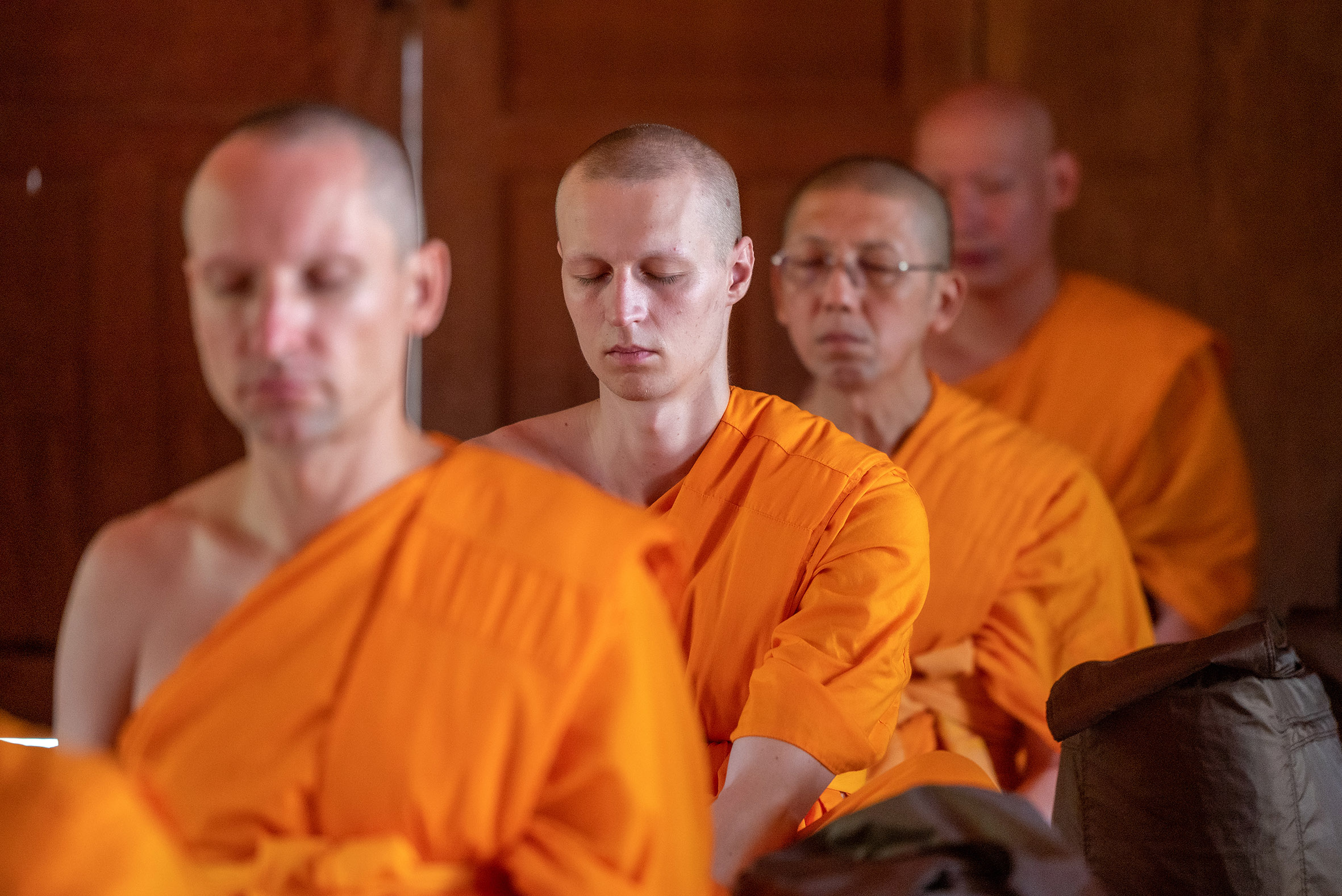
TRADITION & MEDITATION TECHNIQUE

Rooted in Authentic Tradition. Practiced for Modern Life.

The Monk Life Project is shaped by where it takes place and how monks practice every day.

Located in Thailand, the program follows the Theravāda Buddhist tradition and the Sati & Sabai meditation approach as they are lived in Thai monasteries today—not as philosophy alone, but as daily discipline, practice, and way of life.

Rooted in the Theravāda Buddhist Tradition

Theravāda Buddhism is the oldest continuously practiced form of Buddhism, based on the earliest recorded teachings of the Buddha preserved in the Pāli Canon.

Rather than emphasizing belief or ritual, Theravāda focuses on direct experience and personal understanding.

At its heart are three integrated trainings:

Sīla (Ethical Conduct) – living with integrity and restraint
Samādhi (Mental Cultivation) – training attention and inner stability
Paññā (Wisdom) – seeing clearly into the nature of mind and reality

Together, these form a clear and practical path for understanding suffering and freedom.

Theravāda Buddhism has been preserved for over 2,500 years through:

• Monastic discipline
• Meditation practice
• Ethical living

It remains actively practiced today in Thailand, Sri Lanka, Myanmar, Laos, and Cambodia, where monks live and train within a continuous monastic system.

Because the Monk Life Project takes place in Thailand, and because Thai monks are ordained and trained within the Theravāda monastic system, this is the tradition naturally lived and experienced throughout the program.

Understanding the Buddhist Traditions (for Non-Buddhists)

Over time, the Buddha’s teachings spread across cultures and regions, giving rise to several major Buddhist traditions. While all share the same core aim—freedom from suffering through wisdom and compassion—they differ in emphasis and method.

Theravāda Buddhism – The Early Monastic Tradition

• Focus on mindfulness and meditation
• Ethical discipline and simplicity
• Direct observation of the mind
• Minimal symbolism and ritual

Mahāyāna Buddhism – The Path of Universal Compassion

Strong emphasis on compassion for all beings
• The Bodhisattva ideal
• Philosophical inquiry and devotional practices
• Widely practiced in East Asia (China, Korea, Japan, Vietnam)

Tibetan Buddhism – Vajrayāna and Symbolic Methods

• Rituals, mantras, and visualizations
• Symbolic and esoteric teachings
• Close teacher–student transmission
• Traditionally practiced after long foundational training

The Monk Life Project reflects Theravāda practice because it is the living tradition of Thai monasteries—not as a statement of superiority, but as an expression of place, lineage, and daily reality.

Meditation: The Heart of Monkhood

Meditation is the core practice of monk life.

The Buddha prescribed meditation as the primary means to:

• Purify and quiet the mind
• Develop clarity and insight
• Cultivate wisdom and inner freedom

For this reason, meditation is the central focus of the Monk Life Project.

Participants do not need prior knowledge or experience.
Practice is guided, supported, and lived throughout the day.

Sati & Sabai Meditation

Awareness with Ease

The primary meditation method taught in the Monk Life Project is Sati & Sabai, a Thai approach to mindfulness widely practiced in forest monasteries.

Sati means awareness or mindfulness
Sabai means ease, comfort, and naturalness
• Together, Sati & Sabai

emphasizes:

• Relaxed, continuous awareness
• Gentleness rather than force
• Stability rather than striving

This approach allows the mind to settle naturally, making meditation sustainable, deeply calming, and especially suitable for modern individuals accustomed to pressure, speed, and performance.

Rather than trying to control thoughts, practitioners learn to observe the mind calmly, allowing clarity and stillness to arise on their own.

The Middle Way Meditation

Rediscovered Inner Balance

The meditation practiced in the Monk Life Project is rooted in the Middle Way, taught by the Buddha as the path leading to Enlightenment.

In his first discourse, the Dhammacakkappavattana Sutta (“Setting in Motion the Wheel of Truth”), the Buddha explained that two extremes should be avoided:

• Sensual indulgence, which leads to distraction
• Self-mortification, which leads to suffering

Instead, the Middle Way leads to:

• Calm
• Clear vision
• Insight
• Enlightenment (Nibbāna)

This Middle Way is embodied in the Noble Eightfold Path, which includes right understanding, right mindfulness, and right concentration.

Luang Pu Wat Paknam & the Center of the Body

Around 500 years after the Buddha’s passing, the meditative understanding of the Middle Way gradually faded, leaving it understood mainly as a philosophy of balanced living.

Luang Pu Wat Paknam, a revered Thai meditation master, rediscovered the Middle Way as a direct meditation method.

After 11 years of intensive practice and study with renowned teachers, he realized that the deeper meaning of the Middle Way lies at the Center of the Body—the point where Prince Siddhattha rested his awareness on the night of his Enlightenment.

This center is located approximately two finger-widths above the navel, along the central axis of the body.

It functions as a focal point of consciousness, much like the focal point of a magnifying glass that concentrates sunlight. When awareness rests gently at this center, the mind gathers naturally, revealing deep calm and clarity.

This is not something to believe in faith, but something to experience directly through meditation.

Daily Practice in the Monk Life Project

Participants practice meditation throughout the day through:

Four guided meditation sessions daily
• Sitting meditation for inner stillness

• Walking meditation to integrate awareness into movement
• Ongoing support from mentor monks

Meditation is not confined to the cushion.
It continues through walking, eating, chanting, working, and silence.

Buddhism for Modern Life

The Monk Life Project presents Buddhism not as a belief system, but as a practical framework for living wisely.

Teachings are applied directly to:

• Stress and emotional regulation
• Relationships and communication
• Work, leadership, and responsibility
• Loss, grief, and uncertainty
• Meaning, purpose, and fulfillment

Participants learn how ancient wisdom can be lived fully in the modern world—without withdrawing from life, and without losing inner peace.

In Simple Terms

Tradition: Theravāda Buddhism, as practiced by Thai monks
Meditation: Sati & Sabai / Middle Way meditation
Method: Awareness with ease, centered at the body’s core
Aim: Calm, clarity, wisdom, and sustainable inner peace

The Monk Life Project does not ask participants to adopt beliefs.

It invites them to experience the practice directly—and discover its truth for themselves.

Message us